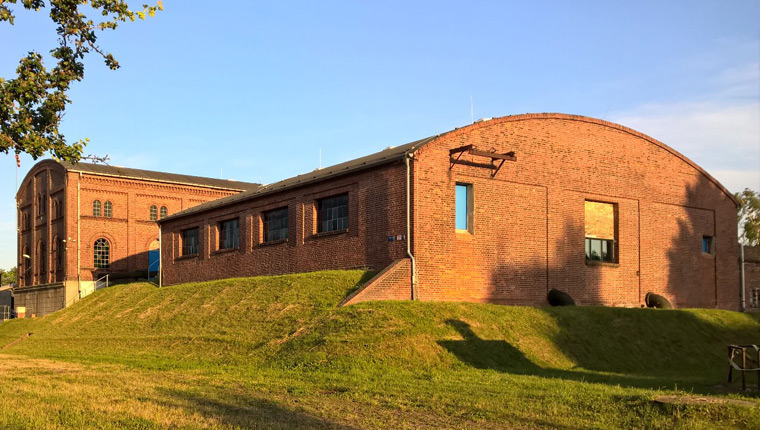
Waterworks Dessau, Wasserwerkstraße 20c. From June to November 1930, the conversion of the municipal waterworks, whose buildings dated back to the 19th Century, took place. As industrial buildings, the main machine hall, the quick filter plants and the clarification tanks were modernised, and provided with a Junkers steel slat roof construction, according to patent no. 459 038 from 25.11.1924 and patent no. 462 881 from 10.11.1925. Junkers Stahlbau carried out the works, a building measure which has even proven itself in the course of technical modernisation.
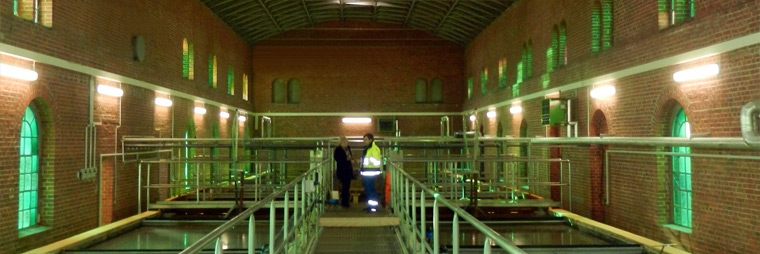
The two large buildings for water treatment, in the Dessau waterworks, have a roof construction without supports, in the Junkers steel slat design.
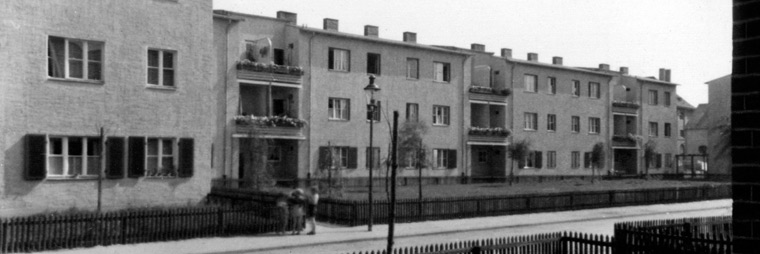
Row of terraced houses in Fröbelstraße, 1935.
Residential buildings Fröbelstraße, designed in 1934/35 by the architect Paul von Sommer in connection with the Junkers architecture office. Still following the traditions of the modern in the building design, flat roof rows of houses emerged for Junkers employees. At this time, it was a special feature to be able to build a flat roof, which the architectural office was proud of. When the national socialists seized power, this roof shape was seen as "unGerman" in residential building.
In the course of the dismantling of the city (around 2000), the houses were demolished.
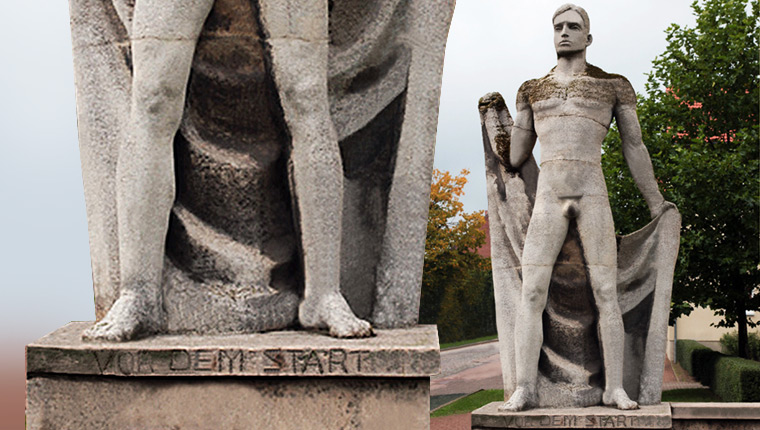
The pilots memorial in Heidestraße, donated by the Junkers factories, stands in a street which leads to a former Junkers residential settlement of the 1930s.
Pilots memorial "Vor dem Start" [Before the start].. At the suggestion of Prof. Hugo Junkers, the artist Walter Kieser designed a memorial to the beginnings of aviation in 1933, the 50th anniversary of the founding of the "Deutscher Verein zur Förderung der Luftschifffahrt" [German Association for the Promotion of Airship Aviation]. It stands as an architectonic decoration, in a Junkers employee settlement, which today is described as an artisan's quarter.
The settlement arose in 1935/36 between Heidestraße and Kabelweg. A building procedure, which still went back to the intentions of Prof. Junkers, which he promoted as a member of the association Wohnungshilfe Dessau. The pilots memorial symbolically represents mankind's dream of flying. It was inaugurated in 1936, 40 years after the fatal crash of Otto Lilienthal during a test glider flight.
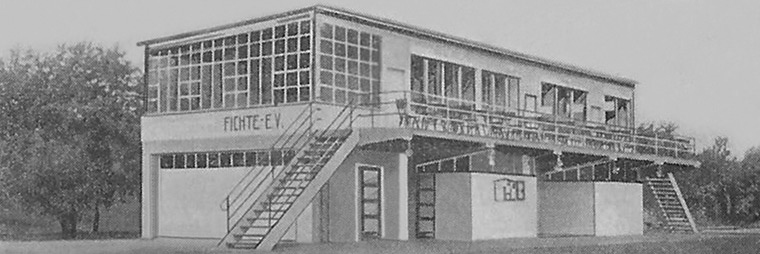
Directly on the Mulde stood the flood protected sports home "Fichte". The structures in the basement were temporarily designed, and could be quickly disassembled in the case of a flood risk, 1931
Sports home of the gymnastics club "Fichte", Dessau, in Tannenheger, today the premises of the Paul-Greifzu stadium. In 1931 as a student of the Bauhaus architecture department, under the management of Mies van der Rohe, Helmut Schulze designed a modern, flood protected sports home in Tannenheger an der Mulde, for the workers sport association of Dessau. The construction was carried out in 1932, financed by donations, whereby the Junkers factories sponsored the provision of thermotechnology devices. The gymnastics association Fichte was a meeting and relaxation place popular with everyone, where you could spend your leisure time actively, in sport and games and using the bathing facilities in the immediate vicinity "Nixe" and "Tannenheger". On 7 March 1945, the whole leisure facility was destroyed by a bomb attack.
© 2022 Junkers-Pfad Dessau. Alle Rechte vorbehalten
Imprint / Disclaimer / Privacy


