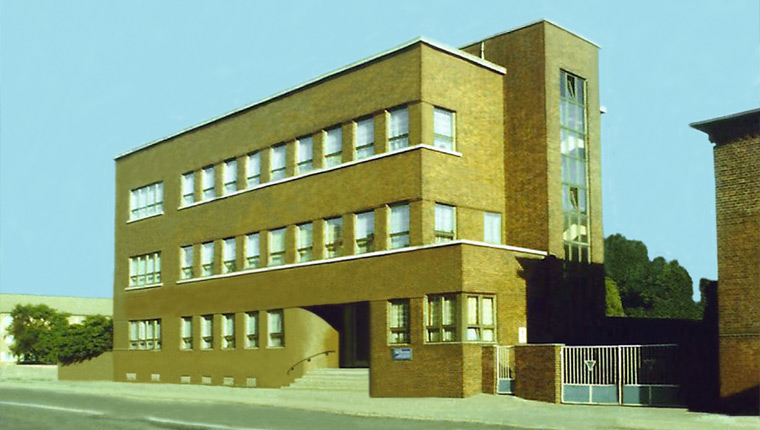
"Junkers town Dessau-West"
- 15.1. Location "digital sculpture"
- 15.2. Junkers-Kaloriferwerk and calorimeter building
- 15.3. Junkers-Stahlbau
15.1. Location "digital sculpture"
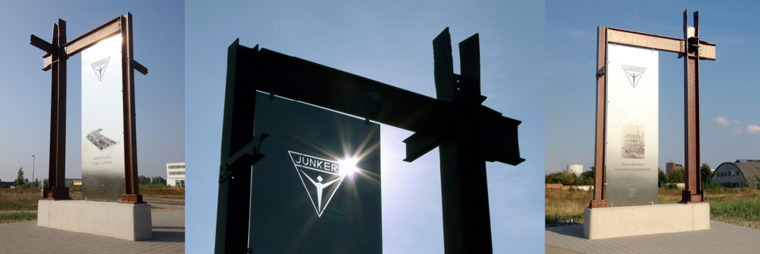
The "digital sculpture" has been part of the commemorative culture of the city of Dessau since 25.07.2016, and is part of the Junkers trail.
The "digital sculpture", design architect Dieter Bankert, is reminiscent of one of the most important creative places of Prof. Hugo Junkers, which was demolished between 2010 and 2012. At the site of the sculpture, which is made of fragments of the steel construction of the administration building of Kalorifer factory; the following companies were located: Junkers Kalorifer factory (founded in1908, in Dessau since1914), Junkers calorimetre (1921), Junkers-Stahlbau (1926) and the central apprenticeship training of the Junkers factories (1927). The technical equipment of the companies was used worldwide. People valued the modern Junkers technology, especially its high level of reliability and long lasting quality. Junkers steel constructions are still proving themselves today in Europe, Asia, North and South America. In the VEB Junkalor Dessau (1948-1990), combustion measurement devices, gas analysers, equipment for dynamic flow rate measurement and medical technology measurement devices of a world class standard, were built at the historical location.
15.2. Junkers-Kaloriferwerk and calorimeter building
Cöthener Str.27, 1928 Junkersstr.103, from 1948 Altener Str.43
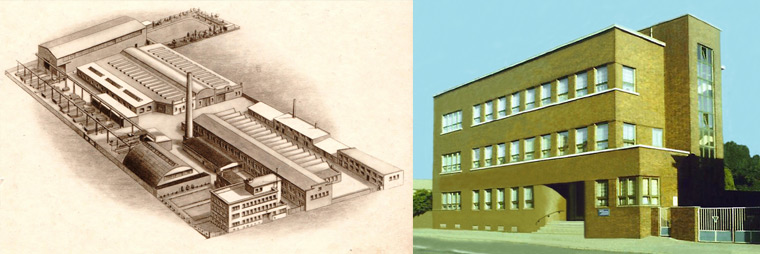
Overall view Junkers Kaloriferwerk, later Junkalor Dessau, isometric graphic 1937. The administrative building of the company was the last building, which was built in line with the intentions of Prof. Hugo Junkers in Dessau, photo from 1976. It was demolished in November 2012.
-
Round arch hall D 108, central receipt of goods and shipping point for kalorifer, calorimetre and steel construction. Built in record time: 08.09.-12.09.1929, roofing ceremony on 10.09.1929, architect: Ottokar Paulssen, architecture office Junkers. The construction sequence of the Junkers steel slat construction was filmed. An instructional film was made as assembly instructions for hall constructions of this type. Conversion of the large hall in the Junkers-Kaloriferwerk into a workshop and office building, project May 1934, design: Dr.-Ing. Wilhelm Klingenberg (according to patent no. 566 844 from 05.12.1930). One of the most innovative project processes by Prof. Junkers, in which an industrial hall was able to be varied for the relevant room requirement, due to a slidable, telescopic roof construction in the Junkers steel slat construction, and so took into account the economic viability. The project was never constructed.
-
Administration building Kaloriferwerk Hugo Junkers GmbH, 1935/36.
Artistic design: Heinrich Ehmsen 1933, architectural design: Karl Schmidt, statics and construction: Dr.-Ing. Wilhelm Klingenberg; construction Junkers-Stahlbau: a steel skeleton construction with stony iron roofs and clinkered outer walls. Although the construction varied from the artistic design of Ehmsen (concessions to the conditions of the time), this skeleton construction had modern constructive and building technology solutions, meaning that it was rightly accepted in to the district monument list of the DDR (VEB Junkalor Dessau). After the conversion of VEB Junkalor Dessau to a GmbH in 1990, and its subsequent privatisation by trust, the company was liquidated in the following period. The monument protected properties at this site, the administrative building and the Junkers steel slat hall, were left to fall into decay. In 2003 the city of Dessau set the demolition day for the Junkers steel skeleton construction, which the senior monument protection authority in Halle approved in spite of public opposition. "Today, the administration building must be seen as one of the most important regional architectural testaments to New Building, whereby the influence of the modern era on the Dessau buildings can not be overlooked. Due to its particular location, which is linked to the changed road layout at the time,. the building is also of great town planning importance. From a city and technical history point of view, the building is an important source of information, about the effect of Hugo Junkers in Dessau. Seen as an outstanding testament to the collaboration of Hugo Junkers and his architectural office, with the artist Heinrich Ehmsen, whose few architectural designs should be protected."
(Source: State office for monument protection, 23. 10. 2001)
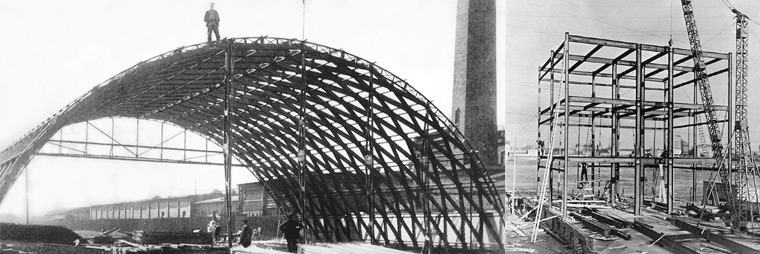
Round arc hall for the Kaloriferwerk in raw construction, 1929. Steel skeleton of the administration building in the building phase 1935/36
-
Central teaching workshop of the Junkers factory, Kaloriferwerk. Here, Marcel Breuer, manager of the Bauhaus carpentry workshop, finished the first prototypes of his famous steel tube furniture between 1925/28. The building is no longer here today.
15.3. Junkers-Stahlbau
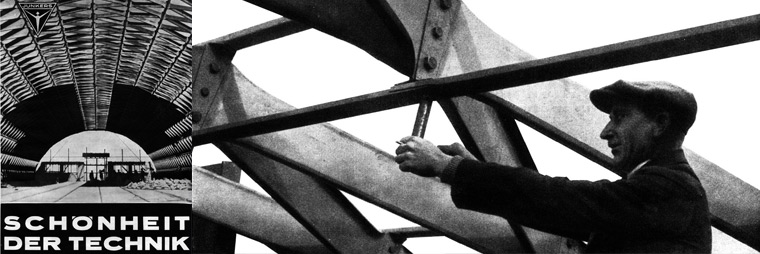
Promotion and assembly presentation on Junkers steel slat construction, 1929.
Cöthener Straße, 1928 Junkersstr.103
- Production and assembly hall I for Junkers-Stahlbau, 1934/35, directly on the railway line Dessau-Köthen, parallel to the Schwarzen Weg, laid out in the direction of Junkersstraße and extended later. Designed as a modern steel construction in a flat roof half-timbered construction with filled facing stone masonry, and skylight strips attached at the side.
- Production and assembly hall II for Junkers-Stahlbau, 1938, construction carried out as round arch hall with a new rod network construction according to patent no. 689 228 from 18 August 1938. After the closure of Junkers-Stahlbau in 1948, the later cement plant took over the hall and converted it into a sports hall for BSG ZAB Dessau in the mid 1960s. After extensive renovations between 2000-2002, today's Anhalt Arena represented itself as the second largest sports hall in the state of Saxony Anhalt, with up to 3,700 places.
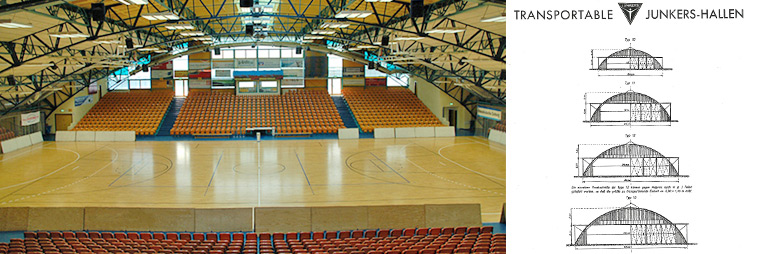
Anhalt-Arena Dessau, a Junkers steel rod construction, modernised from 2000. Interior and exterior view of the sports hall.
These Dessau operations, which traded under the name "Hugo Junkers Werke GmbH München" in 1941, were subordinated to the German revision and trust public limited company of the Soviet occupation zone in 1946, on the instruction of the Soviet military administration of Germany (SMAG), and transferred into public ownership in1948.